Two records. They do not agree.
One record is kept by governments and scientists. The other is made of what people say they have seen. Here are both, sourced line by line, with what nobody knows said plainly.
The United States has ruled the eastern cougar extinct. Source [1] Canada’s official answer is “data deficient”. Source [2] Source [11] New Brunswick listed the eastern cougar as endangered in 1996. When the province replaced that law in 2013, the cougar was not carried onto the new list, and it is not on it today. Source [3] Source [4]
That is one record. This is the other. The New Brunswick Museum has received “hundreds, if not thousands” of cougar reports it has been unable to confirm. Its curator has said some of them “do seem quite credible”. Source [5]
Neither record settles it. What follows is what each one holds, in order of date.
The record
-
1800s · New Brunswick and the states to the south
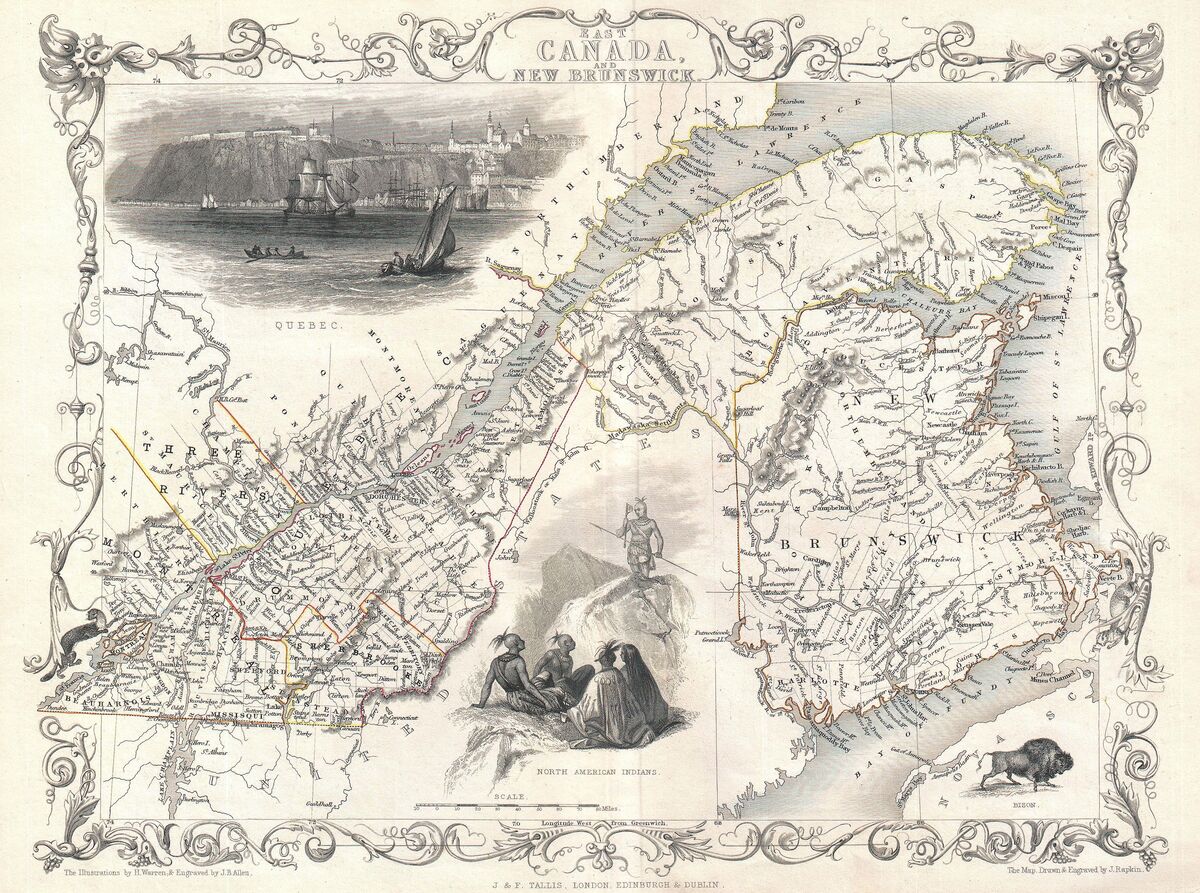
Through the 1800s New Brunswick paid bounties on wolves and bears, and governments to the south paid them on cougars. The forests were cut and the deer went with them. We found no record of a cougar bounty in New Brunswick. Source [6] Source [7]
-
March 1932 · Mundleville, Kent County
A cougar is reported shot near Mundleville, New Brunswick. All that survives is a photograph of its skin. The New Brunswick Museum’s curator has said he cannot be certain the animal came from the province. Source [7] Source [5]
-
1938 · The Maine and Quebec border
The last eastern cougar the United States accepts is trapped on the Maine and Quebec border. It is in the New Brunswick Museum. Source [7]
-
1951 to 1970 · New Brunswick
Black cats turn up again and again in New Brunswick reports; the wildlife biologist Bruce S. Wright, who wrote two books on the eastern panther, logged twenty between 1951 and 1970. No black cougar has ever been authenticated anywhere in North America. Black bobcats, however, have been documented in this province. Source [7] Source [8] Source [9]
-
1992 · New Brunswick
A provincial biologist documents tracks and a scat, and the Canadian Museum of Nature identifies cougar hair in the scat. The authors’ own caution, as the 2018 U.S. rule quotes it: “these data lend little support to the existence of a remnant Eastern Cougar population. It is possible that the animal responsible for the tracks could have been an escaped or released animal.” Source [10] Source [1]
-
30 April 1996 · New Brunswick
New Brunswick lists the eastern cougar as endangered. The regulation names it: “Eastern Cougar (Felis concolor couguar)”. On 3 June 2013 a new list replaces the old one, and the cougar is not on it. Source [3] Source [4]
-
April 1998 · Canada
Canada’s scientific committee files the eastern cougar under “data deficient”. Its definition: “a species for which there is insufficient scientific information to support status designation”. The same committee, COSEWIC, had designated the animal Endangered in April 1978. Source [2]
-
2001 to 2012 · Quebec, New Brunswick and Nova Scotia
Researchers run 38 scratching posts across the three provinces and collect 476 hair samples. Nineteen are cougar, all in Quebec and New Brunswick, and the 2018 U.S. rule notes that several probably came from the same animal. Source [12] Source [1]
-
2003 · Fundy National Park
Hair snagged at two stations in Fundy National Park is confirmed by DNA as cougar: two animals. One carries a genetic signature from South or Central America, which points to an escaped or released captive. The other is North American, and where it came from has never been established. Source [13] Source [12] Source [7]
-
2011 · Milford, Connecticut
A young male cougar is killed by a car. It had travelled more than 2,450 km in a straight line from the Black Hills of South Dakota, with no sign of captivity. The study’s authors add that this “further confirms the lack of a breeding population in the region”. Source [14]
-
January 2017 · New Brunswick
CBC News reports that DNA tests on two suspected New Brunswick cougar sightings found bobcat. Source [15] The same month Donald McAlpine, the New Brunswick Museum’s curator of zoology, makes the remarks quoted at the top of this page. Source [5]
-
23 January 2018 · United States
The U.S. Fish and Wildlife Service publishes its rule: the eastern cougar is extinct, and comes off the U.S. endangered list on 22 February. The rule says the animal “likely has been extinct for many decades, long before its listing”. It had been listed in 1973. Source [1] Source [16]
-
June 2025 · Near Mount Carleton · Testimony
The host of this series says he has seen one twice. The second time was in June 2025. He has no photograph, and he did not look for tracks. On the ladder further down this page, his account sits on the bottom rung. Source [17]
-
Today · New Brunswick
We found no DNA-confirmed cougar record for New Brunswick after 2003. That is the result of a search, not proof of absence.
Who says what, today
-
United States: declared extinct
In January 2018 the U.S. Fish and Wildlife Service ruled the eastern cougar extinct and removed it from the U.S. endangered list. Source [1] Its own review had concluded in 2011 that the animal had probably been gone since the 1930s. That review sent no surveys to the eastern Canadian provinces, though it reviewed other sources for them. Source [7]
-
Canada: data deficient
The 1998 designation still stood on the federal list of October 2021, and we found no reassessment since. Source [11] The cougar is not on Schedule 1 of the federal Species at Risk Act; the word does not occur anywhere in the Act. Source [19]
-
New Brunswick: not listed
Endangered in 1996; absent from the province’s list since 2013. Source [3] Source [4] We found no statement on the cougar from the Government of New Brunswick: no fact sheet, no reporting page, no stated position on its website.
-
Nova Scotia: no confirmed evidence
The Department of Natural Resources told Global News in April 2026 that there has been “no confirmed evidence of cougars in Nova Scotia since before 1900”. Source [20]
-
Quebec: no proof of a breeding population
Quebec lists the cougar as likely to be designated threatened or vulnerable, and says no scientific proof establishes a viable breeding population there (our translation). Source [18]
Only the United States has ruled the eastern cougar extinct. No Canadian government has.
Is there even such a thing as an “eastern cougar”?
Geneticists now doubt the eastern cougar was ever a separate kind of animal. A study published in 2000 found North American cougars genetically alike. Source [21] In 2017 the IUCN Cat Specialist Group tentatively recognised two subspecies for the whole species, with all of North America in one. Source [22]
If they are right, the question is not whether a lost subspecies survives. It is whether cougars live in New Brunswick.
What the sceptics say
This is the case against, at full strength. We do not answer it here.
-
It was something else.
The first argument is the simplest: an animal seen for seconds, far off or in poor light, can be taken for a bigger one. When DNA from two suspected New Brunswick cougar sightings was tested, the answer was bobcat. Source [15] No black cougar has ever been authenticated anywhere in North America; black bobcats have been documented in this province. Source [7] Source [9]
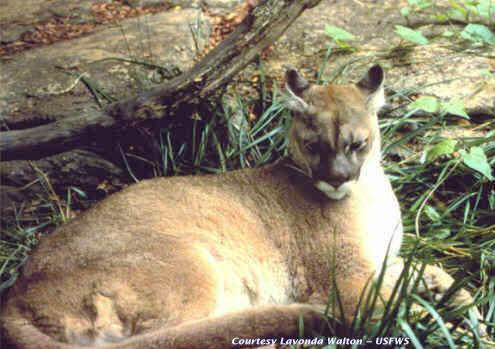
Image via Wikimedia Commons. Credit printed on the picture: Courtesy Lavonda Walton, USFWS. This is not a New Brunswick animal. -
It was somebody’s animal.
One of the two Fundy cougars carried a South or Central American signature. So did six of the nineteen hair samples; ten were North American and three were not sequenced. A cougar killed in Abitibi, Quebec, in 1992 carried a South American one. Source [12] North American does not mean wild: for the second Fundy animal, wild or captive origin could not be determined. Source [7] The 1998 Canadian status report, as the U.S. review quotes it, calls escaped captives “at least the major, if not the only, source of wild sightings”. Source [7] Source [23]
-
It was passing through.
The Connecticut cougar showed no sign of captivity, and it had come from South Dakota. The scientists who documented it concluded that it “further confirms the lack of a breeding population in the region”. Source [14]
-
It may never have lived here.
McAlpine has also said there may never have been a resident cougar population in New Brunswick. Source [5] The 1998 report, again as the U.S. review quotes it, found “no objective evidence ... for the continuous presence of cougars since the last century anywhere in eastern Canada”. Source [7] Source [23]
-
The trail stops in 2003.
The hair study ran until 2012, and its only New Brunswick samples are the two from Fundy. Source [12] We found no DNA-confirmed record for the province since. The U.S. rule: “it also is highly unlikely that an eastern puma population could remain undetected since the last confirmed sighting in 1938.” Source [1]
That is the case. Anything this series puts forward will have to get past it.
What would count as proof
Evidence comes in grades. This is the ladder as we see it, from the bottom rung up.
-
Rung 1
An eyewitness account.
Where every search starts. By itself it proves nothing. The doubt belongs to light, distance and memory, not to the person.
-
Rung 2
A photograph or video, with the original file.
Not a screenshot or a forwarded copy, so that someone else can examine it.
-
Rung 3
Tracks, photographed with a scale.
Something of known size beside the track.
-
Rung 4
Hair or scat, tested for DNA.
DNA can name the animal. At Fundy it also pointed to a captive, and could not say whether the other animal was wild.
-
Rung 5
A body.
The 1938 animal is one. The Connecticut cougar is another.
The standard this series holds itself to
- An account is published as an account. Nothing here is called confirmed because a witness, or the host, is sure.
- Nothing is called a cougar until someone qualified to judge has examined the evidence.
- Results are reported whichever way they fall. A bobcat is a result.
- No animal is called wild, and no single animal a population, without evidence for that too.
- The series cannot promise what it will find. If it finds nothing, it will say so.
What nobody knows
- Whether a cougar is living wild in New Brunswick today.
- Where the second Fundy animal came from.
- Whether New Brunswick ever had a resident, breeding population.
- Where the animal in the 1932 photograph came from.
- What the reports the Museum could not confirm really were.
- Whether the “eastern cougar” was ever a separate kind of animal.
Canada’s official category says as much in two words: data deficient.
The file
If you have seen one in New Brunswick, your account belongs in the file. It will be treated as what it is: an account.
Your email address and the exact location are never published.
How the series means to look Ryan’s own account
The file is still open.
Sources
How to read this list
A number in brackets on this page leads to a source below. Where we looked for something and did not find it, we say “we found none”, which is not the same as “there is none”.
-
Source [1]
U.S. Fish and Wildlife Service. Final rule determining the eastern puma (=cougar) to be extinct and removing it from the U.S. endangered list. Federal Register 83 FR 3086 (FR Doc. 2018-01127), published 23 January 2018, effective 22 February 2018.
-
Source [2]
Government of Canada. Canadian Species at Risk, November 2002 (COSEWIC list). Entry for Cougar (Eastern population), Puma concolor couguar.
-
Source [3]
Province of New Brunswick. N.B. Reg. 96-26 under the Endangered Species Act, in force 30 April 1996, section 2(1).
-
Source [4]
Province of New Brunswick. N.B. Reg. 2013-38, List of Species at Risk Regulation, in force 3 June 2013.
- As filed: https://www2.gnb.ca/
content/ dam/ gnb/ Departments/ ag-pg/ PDF/ RegulationsReglements/ 2013/ 2013-38.pdf - Current consolidation, “consolidated to September 21, 2026”: https://laws.gnb.ca/
en/ document/ cr/ 2013-38
- As filed: https://www2.gnb.ca/
-
Source [5]
CBC News. “Cougar skulls, skin, and DNA”. 14 January 2017.
-
Source [6]
Province of New Brunswick. An Act to grant a bounty for the destruction of bears and wolves in the province, passed 30 March 1848. British North America Legislative Database, University of New Brunswick.
-
Source [7]
U.S. Fish and Wildlife Service. Five-year review of the eastern cougar (lead author Mark McCollough), with Appendix B. March 2011.
Our references to Wright’s count of black-cat reports and to the 1998 Canadian status report are taken from this review, not from those works.
-
Source [8]
Bruce S. Wright. The Ghost of North America: The Story of the Eastern Panther. Vantage Press, New York, 1959; and The Eastern Panther: A Question of Survival. Clarke, Irwin, Toronto, 1972.
Confirmed from library catalogues; not read.
-
Source [9]
McAlpine. Canadian Field-Naturalist 135(1), 2021.
Abstract read.
-
Source [10]
Cumberland and Dempsey. “Recent confirmation of a cougar, Felis concolor, in New Brunswick”. Canadian Field-Naturalist 108: 224-226, 1994.
-
Source [11]
Government of Canada. Canadian Wildlife Species at Risk, October 2021.
-
Source [12]
Lang et al. Northeastern Naturalist 20(3): 383-396, 2013.
Abstract read.
-
Source [13]
Bertrand, Kenn, Gallant, Tremblay, Vasseur and Wissink. Canadian Field-Naturalist 120(4), 2006.
Abstract read.
-
Source [14]
Hawley et al. Journal of Mammalogy 97(5), 2016.
Abstract read.
-
Source [15]
CBC News. “Science has spoken on New Brunswick’s great cougar debate”. January 2017.
-
Source [16]
U.S. Fish and Wildlife Service. Press release, 23 January 2018.
-
Source [17]
Ryan Groom. “My Story”. This site, /my-story.
A first-person account. Testimony, not evidence.
-
Source [18]
Government of Quebec. Species sheet for the cougar, updated 3 November 2026 (in French).
-
Source [19]
Government of Canada. Species at Risk Act, full text with schedules, Justice Laws website, “Date modified: 2026-11-02”.
-
Source [20]
Global News. Report of 9 April 2026 quoting the Nova Scotia Department of Natural Resources.
-
Source [21]
Culver et al. Journal of Heredity 91(3), 2000.
Abstract read.
-
Source [22]
Kitchener et al. CATnews Special Issue 11, 2017. IUCN Cat Specialist Group.
-
Source [23]
Scott, F.W. Update COSEWIC status report on cougar, Puma concolor couguar (eastern population). 1998.
Not read: the report was not readable online. Quoted here from source 7.